Monday, February 28, 2011

Bus Blog 10: Solar Experimentation

I was trying to use everything I could find around my shop in the bus.  We were planning on moving soon and clearing-out without wasting was the mode of the mind.
I had originally planned to cover the rear windows of the bus with a sheet of 16 gauge steel and paint it to match the rest.  This seems to be a more traditional step in the anything but traditional world of bus conversion.  Covering/removing the windows not only provides a sleek, uniform exterior but protection that exposed glass does not easily provide.  The plan was set so I bought and cut a steel sheet to size and then, of course, found the solar panels.

I had paid 10 dollars each for a dozen submarine sandwich sized 12 volt solar panels, which now sat in a dusty box in the basement.  The first week with them I set up a series of experiments, drunk and giddy with the potential that solar power provided.  I read everything I could, growing to understand how they work and what is required to incorporate them into a functioning system.  Then, as usual life got in the way, rent was due, deadlines approached, things needed attention.  I had been re-purposing lamps and furniture from discarded material for years and really wanted to add solar technology to my work, but I already had suppliers and experience working with household current.  I set the panels aside, thinking, "One day."

I consider moving into a school bus a bit transformative.  You have to get rid of the extras and define your future goals.  When I had extra time, I'd go through my workshop, approaching half-finished projects with a temperament that began as nostalgic trepidation and ended as ruthless marauding.  I'd start gingerly placing things in boxes (just in case), but eventually end-up just burning stuff and drinking beer.  Separating ourselves from the past and old ideas is never easy, but beer and fire help, especially if it's cold out.
"Throw another one of those on the fire, it's cold."
"What is that, anyway?"
"Flammable."

The solar panels were different, I could use them.
After a bit of testing, I found 7 had the output I liked.  Instantly, the bus design changed.  Why not?  I could always just cover the windows up from the outside...

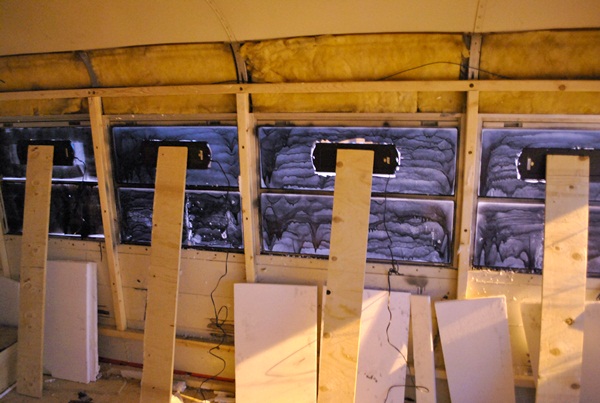
Using silicone, I glued the panels to the windows I planned to cover, painted the glass around them black (not the best choice, but I really wasn't concerned with esthetics) and used ply cut-offs to hold them in place until dry.

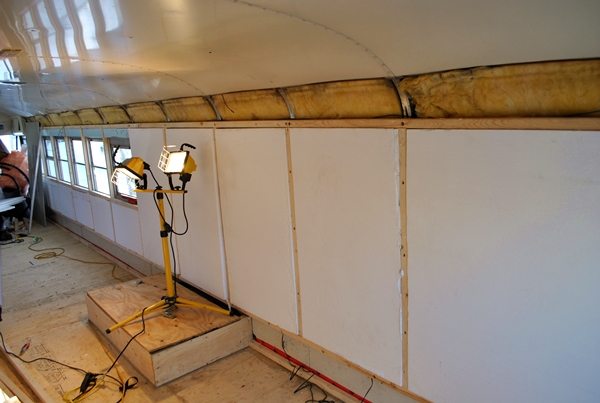
Of the paints I tried, the spray enamel worked the best, and even though it looks bad from the inside, once covered by insulation, the windows look jet black from the exterior.  The acrylic I used was a bad idea, live and learn.  Since the windows are set out from the walls, brought the surface flush with 1/2" styrofoam, then proceeded to insulate as I did the floor.

Since the floor was a load bearing surface and needed to be very flat, I used the best of the poorly cut insulation I had purchased.  The rest, went on the walls.  The Styrofoam cut and slipped into the frame easily.  I'd deal with the proud bits later, for now, I just wanted everything to fit, next up was the ceiling.


The way I look at solar energy is it's free.  The average solar panel has a twenty to twenty-five year life span, often guaranteed, and on average, commercially available units take 10 years to completely offset their costs.  This means that for a one-time investment returned in 10 years, you can receive an additional 10-15 years of free power production.  Now consider that 25 years of service coupled with a 6% inflation rate and annual increase in purchased energy costs.  Has your power company ever charged you less per kilo-watt-hour than than the year before?  Doubtful.
Since technology is poised toward efficiency, requiring less energy per device, and since our bills only increase, being self reliant in terms of power production makes sense, and seems to be getting easier.

My small DIY system may not be enough to run every household appliance, but it supplies enough electricity to power the interior lights and a computer through the night, which is alright with me.  I plan to install a much larger system toward the end of this conversion, check out my dream panels: PVL136 UniSolar 136 Watt PV Flexible Solar Panel Laminate - Easy Installation - Peel & Stick

Friday, February 25, 2011

Bus Blog 9: Outer Walls

The next step in our quest to DIY RV were the interior walls.  Because this bus was to serve as a potenial 4 season home, I needed to make sure it could stay cool or hot depending on our needs.  Time was short however, and I was limited to working one day a week.  It seemed best not to strip the entire interior down to the bones, but to simply insulate the existing structure.  If I had had more time, the choice would have been different but at this point it seemed that quick and dirty was the best route.

The only tin removed from the walls was that above the windows, the frame-work that would hold the walls needed to mount directly onto the steel ribbing of the bus.  I ran a top plate across the now exposed ribs, gluing and screwing each 2x2 in place.  The screws I chose to use were self-tapping monsters and expensive, but these walls needed to stay in place despite constant road vibration.
Instead of going straight to the floor with my framing, I decided to mount my sole plate on the steel ledge that  ran the length of the bus 9" above the new floor.  While this decision would cost me a bit in terms of insulation, it would give me the ability to place break-away panels down the length of the bus where I could run wiring or pex plumbing lines and service them without tearing the whole wall open.

Choosing, as we did, to keep all the original windows, we removed the screws holding them in place, using the new studs to act as window anchors.  We went through 2 tubes of PL during this process but strength was a priority.  After running braces below each of the windows, the framing for the most part,was done.  It looked kind of good.

Thursday, February 24, 2011

Bus Blog 8: Fat Man in a Little Coat

I really can't comment at length on the resurgence of skinny pants.  The best I can do is scratch my head and ask, "Why?" It's one thing to wear clothess that fit, it's another to force the fabric to conform to your body.  I don't understand it.  Tight bike shoes, tight climbing shoes, they serve a purpose, but tight pants?  What if you need to suddenly perform a flying axe-kick?  One must be prepared.  Besides, squeezing big stuff into little packages is not the best way to spend your time.

When I asked the insulation company to cut sheets of Styrofoam that were 1 3/4" thick I thought they could handle it.  I thought, unreasonably I suppose, that having a 15 foot computer controlled hot wire cutter and experienced technicians was enough.  I guess you have to load the machine...
The insulation was 1 3/4" thick on one end, and 2' thick on the other.  Each sheet was off by a quarter inch. I had wanted the insulation to stick past the joists a little bit, along with providing a hair more R-value, the Styrofoam pushing up slightly against the sub-floor would add a bit of stability and more sound dampening to the finished floors.  Expecting to push the Styrofoam down an eight of an inch is reasonable, it has a little give and won't argue much.  However, trying to cram an extra 3/8's of an inch down over a wide surface, is a bit more difficult.
I tried cutting thin bits off with a knife, but ended-up beating the stuff down with a mallet, then stomping on it, then deciding to use a lot of screws to pull down the sub-floor.  I had spent most of my day beating the insulation to a tolerable level and was tired.  The act of insulating the floor had turned into a full body work-out.  Usually cutting and applying insulation is quick and easy, but I was sweaty and tired when I finally finished, and time was up.

The next weekend was great, the barrier plastic floated down softly to cover the insulation and joists.  I stapled and taped it in place, making an air-tight sandwich on-top of which the sub-floor would sit.  Good building, like dressing for winter, is all about layers.

The sub floor cut-up easy, each sheet only had to loose a few inches to fit snug between the walls of the bus.  The 40" between the raised wheel-wells in the rear was the only bit that required any additional attention, and it wasn't much at that.  The joints fit together snug and as I picked-up the chalk line to mark my joists, I had a visitor.
"Can you watch Jack?"  My wife, more telling than asking, stepped in the bus, put Jack down and left.
"Sure?"

Jack, my 1st born, sees himself as an adult.  He's not even two and wants to be doing what you're doing no matter what.  If you're cooking, he wants to cook, if you're drilling he want to drill and insists on holding the back of your drill until the hole is made or the screw is in.  He loves hammers and will not hesitate to pick one up and pound anything of interest, he now has a designated rubber mallet, the only hammer he can use until he knows better...

 Up until this point, Jack had not been allowed in because of the work that was going on and was so happy to finally be in the bus that he ran across the sub-floor, slapping the walls and screaming in delight.  This went on for a while, tiny shoes pounding across the floor, and I busied myself with setting up the chalk-line.

One snap and I had Jack's attention, I scooted the hooked-end down a bit, tensed the string.  Curious, he walked over.  He picked up the blue string, "Let go," I said and he did.  He ran madly across the bus as I moved the line forward, coming back as I drew it tight.  He picked the line up again and dropped it, laughed, then took another lap around the bus.  In this fashion, we worked our way down the body of the bus marking-out the joists.  Moments like that give hope to fantasies of working with your kids and give insight (for me at least) of what your parents may have gone through raising you.  My dad always wanted me to work in the jewelery business with him, but I never understood why.  A lot of the time we want our children to be part of our lives, see things the way we see them, I`m starting to slowly appreciate that.

Kirstin stuck her head in the bus, "Dinner."  We headed in.

Another week came and went and with a bit of leveling, the floor was secured.  There were still miles to go, but I felt like we were finally getting somewhere.

Wednesday, February 23, 2011

Bus Blog 7: Hauling Butt

Once again, I was hauling butt across town.  It was a Sunday morning and traffic was light.  The bus, loaded with supplies and tools, maneuvered easily through construction zones and up hills to the new parking spot in the West.  After a few days of worrying about where to park, my in-laws (bless them) allowed me to pull the bus in front of their house and I got on it.
After meeting the neighbors and growing comfortable in the small neighborhood which was my bus's former residence, we were booted.  The conversation went something like:
"Sorry man, but my landlord says the bus has to go."
I smirked, "Really?"
"Yeah, they came by for an inspection and freaked," Jesse looked down, giving news the way some report cards are handed over.
"Did you offer them money?"
"Yeah, I tried everything."
I laughed, "All right, then it goes."
"You're taking this well."
There's always something worse that can happen, so accept bad news and keep going.  As a courier, I broke my wrist, dislocated all my fingers, had my head split open when a Mercedes cut me off, took a short ride underneath a taxi, and beat my knee to death on the icy streets of the North, I've pulled horrible pranks on people and caused trouble throughout my life, it can always be worse. Keep going.

I parked the bus and got to work.  It was time to hustle.  I ran a line of 2x2's down each side of the bus interior securing them with PL-Premium and counter-sunk self tapping screws.  The screws I chose were designed for attaching drywall to steel studs and while lacking the shear-strength (and cost) of beefier varieties, were enough to hold down the wood until the adhesive dried.  PL is strong, so is tar, and with the weight of a sub-floor and floor pressing down on these joists, they wouldn't go anywhere.

The work was easy and went fast, I next cut and laid out, the joists running a support down the middle of the bus stopping at the stairs.  I had planned to separate the front and rear of the bus from the core and so stopped the raised floor just behind the driver's seat.  My bus time was limited so I decided to limit my work to things that had to be done.

My parents came to visit the next weekend and after the obligatory political 'discussion' between my father and I, he was glad to give me a hand securing the joists.  He's always good help, not hesitating to suit-up in a pair of coveralls and glue each piece of wood.  I followed, counter-sinking and screwing them in place.  Once again, the work went quick and I was able to start insulating the floor the next week.

After an adventure involving a windy Saturday morning, a pick-up truck, 11 4 x8 sheets of Styrofoam and 1 ratchet strap, the insulation was loaded into the back of the bus.  It seemed that progress was finally being made.

Tuesday, February 22, 2011

Bus Blog 6: Concentrate

While the tar was hardening on the bus floor, I was offered and accepted a job out of town.  The money was good but the job limited my ability to work on the bus as I was only in town 2 days a week.  That meant I spent Saturdays with the family and Sundays working on the bus, which in theory was possible as long as I was focused.

Taking a break from anything is hard, sometimes even a brief pause can destroy any hope of serious progress.   When we work on things fully there is a flow, there is a vocabulary to it, we think and understand in a context specific to our activities.  It can be damned hard to get going again.
 "Helllooo."
I had been happily scratching dimensions and drawings on a pad of paper, imagining the project, the structure, access points and insulation.  For once I was alone, and wanted to stay that way.  I didn't answer.
"Helllooo in there," the voice repeated.
 I said nothing.
"HellooooOOOOO,"
I hesistated, "Uh, hello?"
"Hi, looks like you've got a bus on your hands."
"...Yes..."
A figure leaned into the doorway at the front, he had a beer in his hand and wore a pair of flip-flops, sunglasses and a tropical print speedo.  A gold chain sat in the suggestion of hair on his chest.  He was painfully tan, the colors red and brown were having territorial conflicts across his body.
"Saw this baby parked here earlier and just came to have a look.  Heard you working couple weekends ago..."  He sipped his beer, "...just came to have a look and see what you're up to."
"Work,"  I didn't have to be a prick about it, "Just figuring out what goes where and how much."
"What for?  What's this all about anyway?"
"We're converting this bus into an RV.  Lot of work to do."  Trying to look busy, I picked-up a tape measure and began measuring the distance between some arbitrary points on the floor.
"I'll say, lot of work to turn this puppy into a RV."  He pulled down his glasses and leaned in the front door, placing his right foot on the first step... unselfconsciously, "Lot of work... Looks like you got a good start..."
"Yup", I said while writing something down and drawing a completely meaningless line.
"So what's the next step here?  You gonna insulate it?"  He patted the door frame.
This continued for a while until he seemed satisfied with my answers and wandered off, saying something about another beer.
It took me ten minutes to remember where I was work-wise, twenty minutes and I was able to start making more meaningful lines on my notepad.  The first order of business was the floor.  I planned to raise it with a series of 2x2 joists, insulate between, vapor-barrier, then seal it up with a ply sub-floor.  This would lower my heat loss in the winter, heat gain in summer and help further deaden any sounds or vibrations while giving me a reliable surface on which to build the various structures within.
Lines began to cross my layout sketch.
"So what eees this?"  An aged, Slavic accent asked from behind.  I turned.

It was of course Sunday and the genuinely curious neighbors made their way over, one by one, poking their heads in the bus and asking questions until satisfied.  The one thing they all agreed on was that I had a lot of work ahead of me.  But I knew that.  I knew it was a lot of work, and I knew that if left alone, I could actually get it done.  But, what do you say, "Yes, I know this giant yellow bus is now in your neighborhood and you're curious, but leave me alone?"  This was their neighborhood and they had a right to be nosy (though nosy in a speedo is pushing it).  I was in their domain and if I made nice now, I may even get some help later, who knows?  Some days nothing gets done, that's life.
 "Screw it," I thought, "I'll stop and talk."

Monday, February 21, 2011

Bus Blog 5: Wipe and Seal

Pressure washers are squirt guns on a mix of steroids and brown-brown.  It was summer and hot and the back-spray from the water cannon I held in my hands was welcome.  The machine uprooted remnants of rust and adhesive from the floor, destroying years of dust, dirt and homogeneous sticky goop that had accumulated, concrete like, in various parts of the interior.
My wife, Kirstin, took a turn and blew the stairs clean with a few sprays of the gun, then shrugged her shoulders, unimpressed.
I took it back from her gladly, using the jet of water to scrub the floor, the lower walls, under the dash, the heaters, the engine, the tires, the windows, I eradicated dirt in every crevasse, crack and hole I could reach.   This went on for a while.  It was only when I climbed back into the bus and began tearing the numbered stickers off the tops of the walls with the jet of water while giggling, that I got a look.  "Are you done yet?"
Water dripped from every surface, it pooled on the floor, ran down my legs, "Gotta use it while you got it."
She maintained her gaze.
"Well, I guess, yes I'm done."

Being the height of a dry summer, water began to evaporate immediately.  With a few whips of a mop and blasts from an air compressor the accumulated puddles disappeared and we broke to let the bus air out.  Later, I patrolled the interior wire brushing, then applying rust converter to anything that had even a reminiscence of an orangish hue, until dark.

The next step, was to roll the steel floor with tar.  Tar is strong, water-proof, flexible, acts as an adhesive, is easy to apply and doesn't cost much.  Several coats of it have the benefit of helping to deaden sounds that would normally reverberate across the bus.  And, what the hell?  If the bus was to be our travelling house, why not invest the extra $40 for a bucket of tar and roller to keep rust away for good?

Kirstin was the obvious choice for applicator.  She is not an artist by any means, she draws things that look like clouds crossed with puddles of vomit and insists on calling them "Dragons", but she can paint like a pro.  While I mainly spill paint at things, my wife can do an entire apartment in one evening, barely mask anything and not spill a drop.  It takes me hours and a box of rags to clean-up after myself; she's done in minutes.  Did I really want to tangle with one of the stickiest substances on earth, or leave it to the professional?
I chose the latter, clad in a tank-top, baggy pants (with two specks of paint on them) and skate shoes, she got to work.  The paint roller and extension whipped up and down the length of the bus depositing a layer of thick, viscous tar with each pass.  There's no messing around with the black goop, it sticks and won't let go easy.  It sucked on to the bare metal floor, for good, we hoped.
If you don't allow water or air to react with a ferrous metal surface, it won't rust.  That's the theory behind tin and galvanized steel, behind nickel and rhodium plating, behind paint and well, tar.  If you don't let the metal breathe, it will stay metal.  If you let it breathe, it will crumble.  We aimed to never let this floor breathe and Kirstin made sure to roll the tar on thick.

While there are a great many benefits to using tar, it stinks, is difficult to wash off, isn't entirely eco-friendly and takes forever to dry.  Our quest to seal the floor properly before construction, cost us a week and a half of drying time, but saved us money compared to other sealing and waterproofing methods.  If you're converting a school bus, check out all the options before deciding.  This blog isn't a 'how-to', it's a 'how-we-did', learn from our successes and failures and things we're too stubborn to admit were bad ideas, then do your own thinking.

Friday, February 18, 2011

Bus Blog 4: Demolition 2

I suppose it's time to mention that I have a bit of an inquisitive nature.  Well, more than a bit really, because while a couple hours searching the web to find info on a topic of interest will satisfy the curiosity of some, I belong to the class of people who absolutely must experience the query in the most tactile sense.  I can't only read about blacksmithing, I have to re-purpose a forge out of an empty propane tank, make my own burner from plumbing parts laying around the shop, buy an anvil, make a series of shop tools, learn to temper, case harden, oxidize, forge, then make any and everything from all the steel I've been accumulating, just in case I decided to take-up blacksmithing.
 While a nature like this is a large part of the reason that I never really seem to take a day off, it certainly comes in handy when I need to rip-up the plywood sub-floor of the bus and need the right tool to do it.  After an hour of work, I fashioned myself a serviceable wrecking bar and headed to the bus to resume demolition.
A potential pitfall of having and 'inquisitive' nature is that your shop tends to look like both a tool catalog and pawnshop exploded and were then organized by a group of dust-covered kindergartners chugging energy drinks.


I had let the bus sit for 2 days with all of the windows down and front door open so the hot summer air could suck the moisture from the sub-floor.  After approaching with a bit of hesitation, I was relieved to find the floors dry and air inside actually breathable.
Since we lacked the space to keep all the ripped-up seats and flooring outside of the bus, we decided it best to pile everything on one side, tear-out the sub and move everything over, then do the other side.  By crisscrossing the exposed floor with cuts from my circular saw, we were able to pull the sub-floor up in smaller, easier to handle pieces.  My homemade wrecking bar made dust of the nails holding down the ply, and as I lifted the sub, I got my first look at the steel panels that everything inside the bus rested upon.
I had been a bit worried about this: the amount of water in the plywood meant that the steel base had been soaking, for who knows how long.  I really didn't want to have to spend a bunch of time cutting out bad panels, welding in new ones, then tarring and spray-foaming the new floor to match the rest of the protected bus bottom.  But, after a few worry-some spots, it turned out that the floor was in great shape.  A little wire brushing, rust converter and a good seal and she'd be ready.

I drove the wrecking bar under the ply and lifted, drove and lifted, the rhythm and tangible progress was enough to make the work quick.  The detritus was shifted to the other side of the bus and it was bare to the steel in no time.  After a few calls to local metal recyclers, the seats were stripped-down to the steel and tin then the various waste was separated into piles.  I re-secured the driver's seat and got ready for the ride to the dump.

Driving a re-purposed school bus takes a bit of getting used to.  It's not as much the driving, as the looks you can get from people, the pointing, the, "Dude's nuts," comments.  That awkward teenager that lives inside of each one of us hoping not to be singled-out or called attention to ducks and hides, infusing us with a desire to conform, why the hell are we doing this anyway?  This will never work.*  So, when I pulled up to the front gate and the guy in the window gave me a look as if his forehead had just been rubbed by a lemon, I did what any awkward teenager who drinks way too much coffee does and began blurting out everything, as incoherently as possible.
"Uh, dumping, uh stuff, floor, uh, turning this into a, seat cushions, plywood, RV, linoleum...  It's insured, no chemicals or anything, and registered, smelled like mildew, mechanic says it'll..."
His forehead relaxed and he smiled, "Oh, I thought you were here for a tour.  I would have let you in free."
"What?"
"You're driving a school bus."
"Oh.  Ohhhhhh!"  I then proceeded to laugh harder than was appropriate.  He gave me a number, another smaller, look of confusion and I headed into the fury of seagulls and mountains of trash.

There wasn't much to it really, I had already stopped at the metal recyclers and ditched all the tin and steel from the seats earning me $30, twenty minutes of tossing old seat cushions and rotten flooring out the back door and ten minutes of serious sweeping later, the bill at the dump amounted to $20, leaving me $10 for lunch.

I headed back, parked the bus and got ready to do a serious clean-out.

If you're curious about blacksmithing, I recommend this book: The Complete Modern Blacksmith it's a fantastic resource from someone who has made it all.  It teaches not only techniques and tools, but ways to improvise if you lack the basics.

*Everyone is different, but sooner or later that nervous teenager of the psyche evolves at first into a cautious adult, then blooms into a fat nudist who has "Screw 'em if they can't take a joke" tattooed across his/her back-side.  I've found that taking on ridiculous projects and challenging the norm are the quickest ways toward this evolution.  Well, quickest healthy way.